The History Boys
Alan Bennett's The History Boys is a rich, provocative exploration of the true purpose of education, set against the backdrop of 1980s Thatcherite Britain. By contrasting the eccentric, humanistic Hector with the results-driven, pragmatic Irwin, the play challenges students to think critically about knowledge, truth, and how we measure success—making it a deeply rewarding text for literary analysis and an excellent vehicle for securing top marks in AO2 and AO3.
Study Notes
Overview
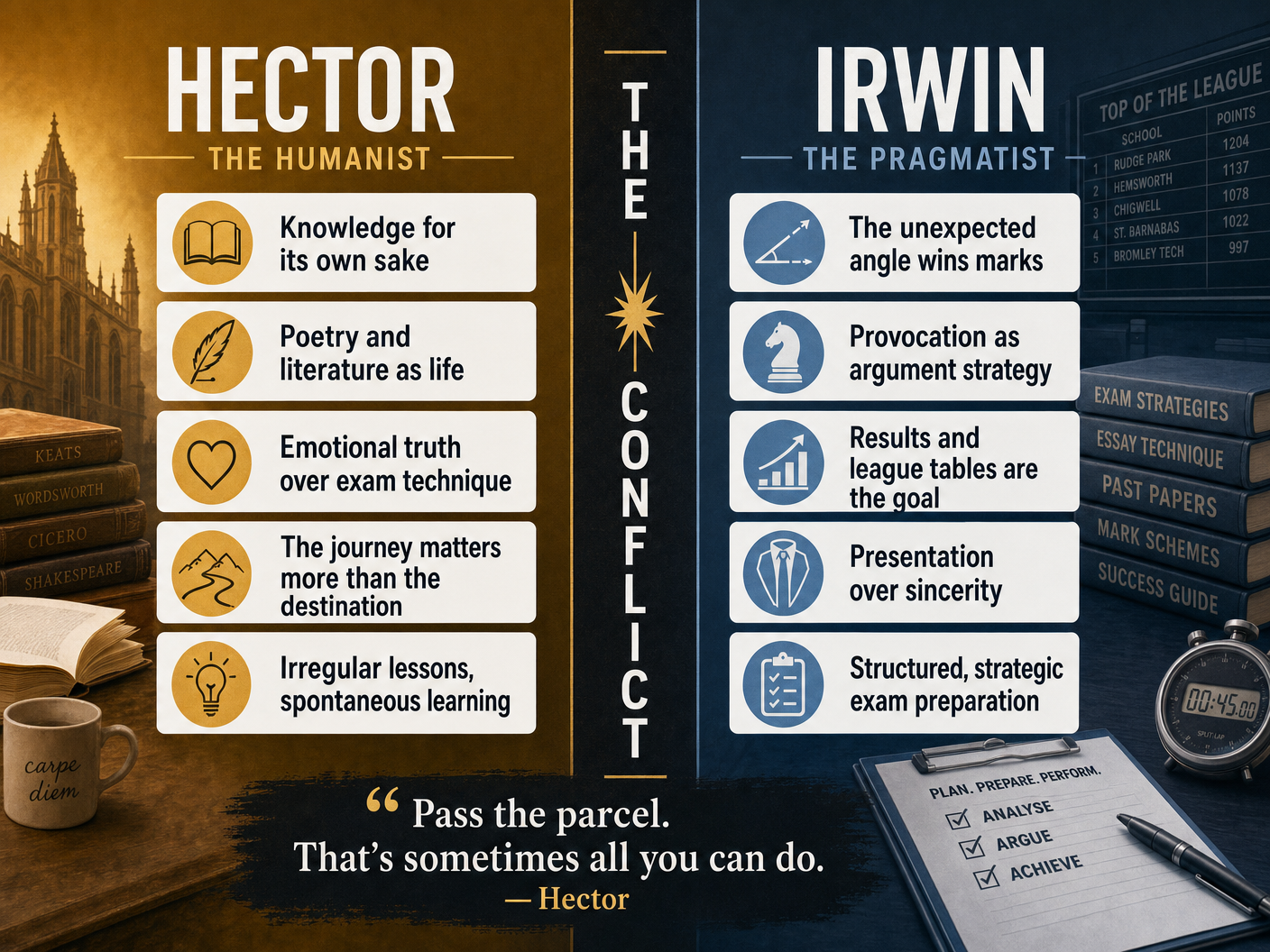
The History Boys, written by Alan Bennett in 2004 but set in the 1980s, is a modern classic that tackles profound questions about education, history, sexuality, and the journey to adulthood. The play centres on eight bright sixth-form boys at a northern grammar school preparing for the Oxbridge entrance exams. Their learning is pulled in opposing directions by two teachers: Hector, an eccentric older teacher who believes knowledge should be absorbed for its own sake, and Irwin, a young, pragmatic supply teacher hired to teach the boys how to pass exams through 'spin' and unexpected angles.
Examiners love responses that recognize the complexity of these characters. Top-tier (Level 5/6) answers avoid simplistic 'Hector is good, Irwin is bad' readings. Instead, they explore how Bennett uses these contrasting figures to satirize the 1980s shift towards league tables and utilitarian education, while simultaneously exposing the flaws in Hector's romanticized worldview. Candidates are rewarded for integrating this context (AO3) seamlessly with close analysis of Bennett's witty, allusion-heavy dialogue and his use of non-linear structure (AO2).
Listen to our comprehensive revision podcast for an in-depth audio guide:
Plot/Content Overview
Act OneThe play opens with a flash-forward to Irwin in the present day as a slick TV historian. The action then shifts back to the 1980s. We meet the boys and their charismatic General Studies teacher, Hector, whose lessons are chaotic, poetic, and focused on 'knowledge for its own sake'. The Headmaster, obsessed with league tables, brings in Irwin to polish the boys for Oxford and Cambridge. Irwin shocks the boys by dismissing truth in favour of presentation, teaching them to take contrarian viewpoints to stand out. Meanwhile, Posner struggles with his unrequited love for Dakin, and we learn of Hector's habit of inappropriately touching boys while giving them lifts on his motorcycle.
Act TwoThe boys attend their Oxbridge interviews and are successful. However, the Headmaster catches Hector in the act on his motorcycle and forces him into early retirement. Dakin, increasingly confident, propositions Irwin, who is unnerved but intrigued. In a tragic climax, Hector gives Irwin a lift on his motorcycle; they crash, and Hector is killed, while Irwin is left using a wheelchair. The play ends with glimpses of the boys' futures—most are moderately successful but unremarkable, except for Posner, who remains isolated and haunted by the past. The final image is of Hector, offering a lasting, bittersweet message about the transmission of knowledge.
Themes
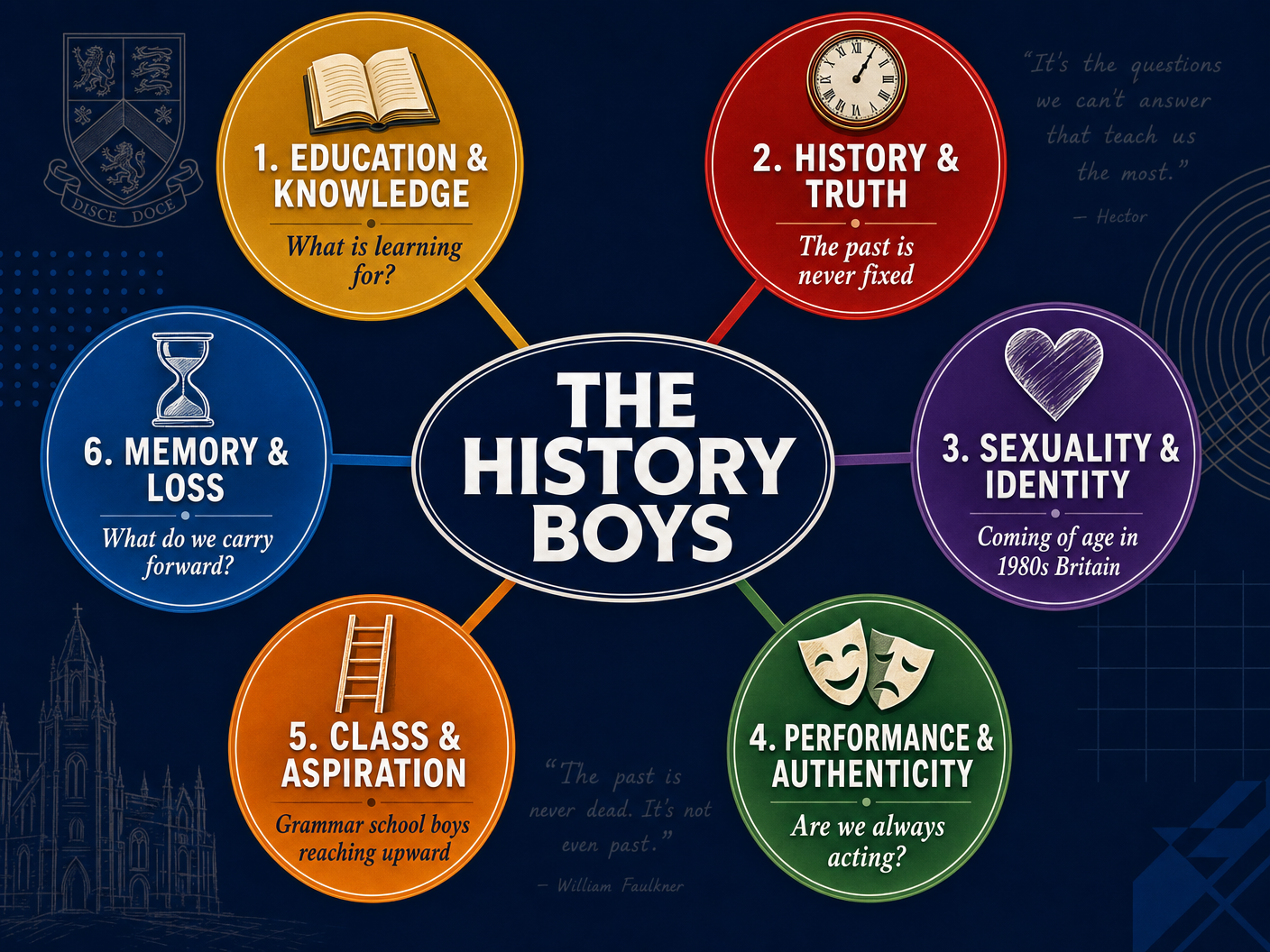
Theme 1: The Purpose of Education
Bennett presents education as a battleground between two opposing ideologies: the humanistic (Hector) and the utilitarian (Irwin/Headmaster). Hector views education as a lifelong companion, a source of solace and moral enrichment. Irwin, conversely, views it as a game to be won, where facts are merely ammunition for an argument. The Headmaster reduces education entirely to statistics and league tables. Bennett uses this conflict to critique the educational reforms of the 1980s, which prioritized measurable outcomes over genuine intellectual curiosity.
Key Quotes:
- "All knowledge is precious whether or not it serves the slightest human use." (Hector, Act 1) - Hector's manifesto. The word 'precious' elevates learning to something sacred, contrasting sharply with the Headmaster's view of knowledge as a commodity.
- "Education isn't something for when they're old and grey and sitting by the fire. It's for now. The exam is next month." (Irwin, Act 1) - Irwin's pragmatism is evident in his focus on the immediate, measurable goal. The juxtaposition of 'old and grey' with 'next month' highlights the temporal conflict between lifelong learning and short-term success.
- "Think charm. Think provocation." (Headmaster, Act 1) - The Headmaster's imperatives reveal his superficial approach. He values the appearance of intellect over actual substance.
Theme 2: History and Truth
Bennett explores how history is constructed, questioning whether objective truth exists or if history is merely a matter of perspective and presentation. Irwin teaches the boys that history is subjective and can be manipulated for effect—a reflection of the emerging postmodern and 'spin' culture of the late 20th century. Mrs Lintott provides a crucial counter-narrative, arguing that history is a male-dominated construct that ignores the experiences of women.
Key Quotes:
- "History is just one fucking thing after another." (Rudge, Act 2) - Often misinterpreted as mere crudeness, Rudge's blunt summary is actually a profound critique of the chaotic, unplannable nature of history, undercutting both Hector's romanticism and Irwin's neat packaging.
- "History's not such a frolic for women as it is for men. To you boys, history is a subject... History is a commentary on the various and continuing incapabilities of men." (Mrs Lintott, Act 2) - Lintott exposes the gendered nature of history. Her use of 'incapabilities' subverts the traditional narrative of male historical triumph.
- "Truth is no more at issue in an examination than thirst at a wine-tasting or fashion at a striptease." (Irwin, Act 1) - Irwin's use of cynical analogies demonstrates his complete detachment of academic argument from factual or moral truth.
Theme 3: Performance and Authenticity
The play constantly questions what is real and what is acted. The boys are performers, adopting different personas for different teachers. Hector's lessons involve literal acting (the French brothel scene), while Irwin teaches them to perform intellectually for examiners. This theme extends to the characters' personal lives, particularly regarding sexuality and identity, where many characters hide their true selves behind carefully constructed facades.
Key Quotes:
- "I am a Jew. I'm small. I'm homosexual. And I live in Sheffield. I'm fucked." (Posner, Act 1) - Posner's stark, staccato list of his identities highlights his acute sense of marginalization. He is the only character who refuses to perform a false identity, making him the most authentic but also the most vulnerable.
- "You give them an education. I give them the wherewithal to resist it." (Hector, Act 1) - Hector sees his role as providing an antidote to the 'performance' of standard schooling, yet he himself performs the role of the eccentric maestro to hide his deep loneliness and transgressive behaviour.
Character Analysis
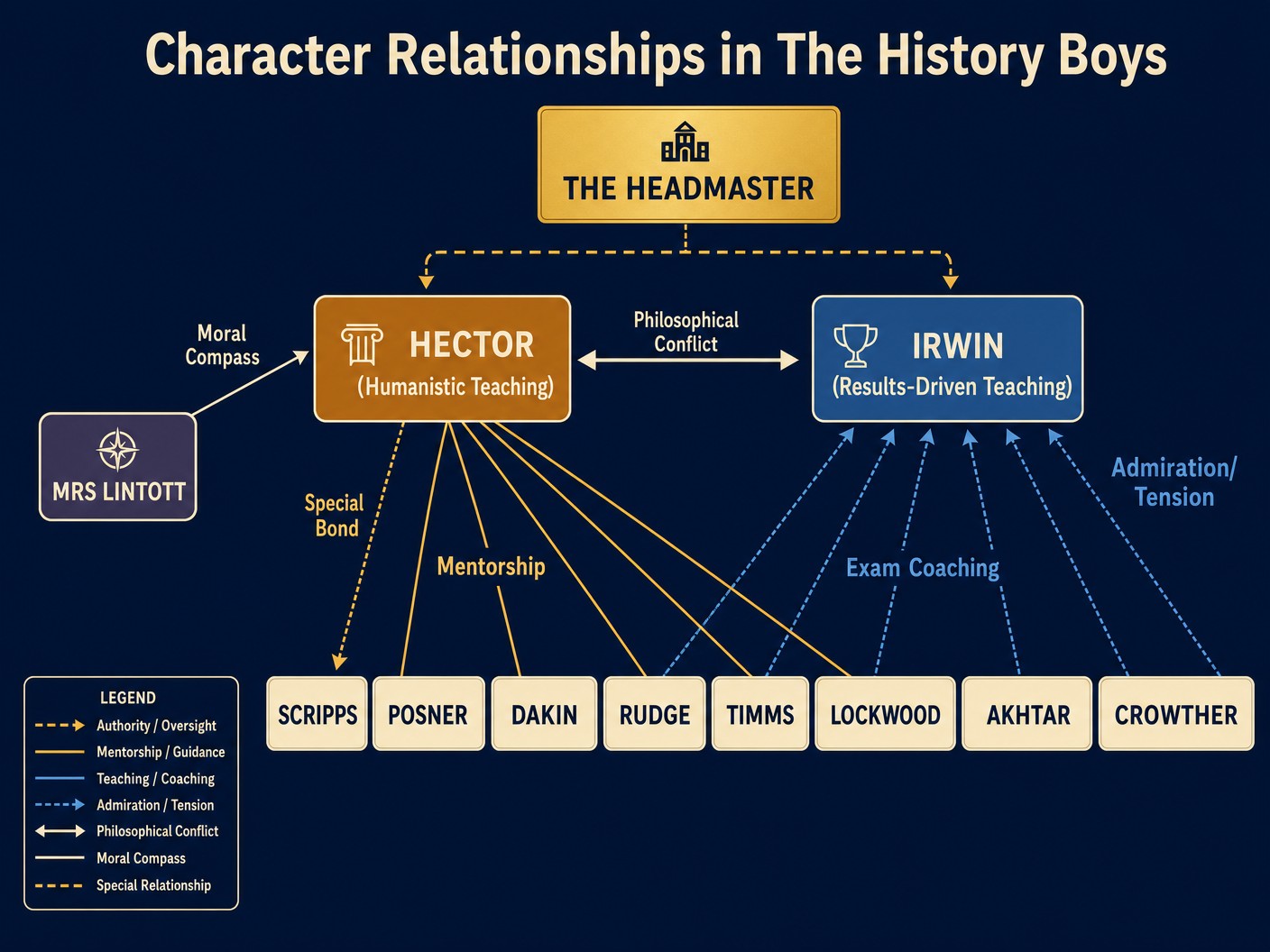
Hector
Role: The General Studies teacher; represents humanistic, literature-focused education.
Key Traits: Eccentric, passionate, deeply flawed, tragic, anti-establishment.
Character Arc: Hector begins as the beloved, undisputed intellectual centre of the boys' world. As Irwin's influence grows and his own inappropriate behaviour is exposed, his authority crumbles. His death cements his status as a tragic figure—a relic of a bygone era of education.
Essential Quotes:
- "Pass the parcel. That's sometimes all you can do. Take it, feel it and pass it on."
- "The best moments in reading are when you come across something – a thought, a feeling, a way of looking at things – which you had thought special and particular to you."
- "What made me piss my life away in this god-forsaken school?"
Irwin
Role: The young supply teacher; represents pragmatic, results-driven education and 'spin'.
Key Traits: Strategic, cynical, emotionally repressed, intellectually provocative but personally insecure.
Character Arc: Irwin arrives confident in his methods but is gradually unsettled by the boys, particularly Dakin's sexual confidence. The motorcycle crash leaves him physically disabled, but the framing device reveals he ultimately succeeds in the superficial world of TV history and politics, validating his 'spin' philosophy even as it rings hollow.
Essential Quotes:
- "The wrong end of the stick is the right one. A question has a front door and a back door. Go in the back, or better still, the side."
- "It's a performance. It's entertainment. And if it isn't, make it so."
Posner
Role: The outsider among the boys; the emotional core of the play.
Key Traits: Sensitive, authentic, melancholic, observant, isolated.
Character Arc: Posner remains fundamentally unchanged in his sensitivity. While the other boys adapt to Irwin's methods and move on to successful, conventional lives, Posner cannot compartmentalize his feelings or his learning. He ends up isolated, the only one who truly took Hector's teachings to heart, bearing the emotional weight of the past.
Essential Quotes:
- "I'm a Jew. I'm small. I'm homosexual. And I live in Sheffield. I'm fucked."
- "He was a good man but I do not think there is time for his kind of teaching anymore." (Older Posner reflecting on Hector)
Mrs Lintott
Role: The traditional History teacher; the moral and rational compass.
Key Traits: Pragmatic, observant, feminist, grounded, truthful.
Character Arc: She remains a stable force throughout, observing the male ego-battles around her with wry detachment. She survives the educational shifts by remaining competent and unassuming, eventually providing the most piercing critique of the male-dominated world of the play.
Essential Quotes:
- "I'm the only one who tells them the truth."
- "History is a commentary on the various and continuing incapabilities of men."
Writer's Methods
Bennett employs a range of dramatic and literary techniques that candidates must analyze (AO2):
1. The Framing Device and Non-Linear StructureThe play is framed by scenes of Irwin as an older TV historian, and features flash-forwards to the boys' futures. This creates dramatic irony (we know Hector will die) and forces the audience to view the 1980s action through a lens of memory and hindsight, reinforcing the theme of history as a construct.
2. Intertextuality and AllusionBennett saturates the dialogue with quotes from Auden, Hardy, Shakespeare, and Larkin. This isn't just showing off; it demonstrates Hector's philosophy in action. The boys speak in borrowed words because they are still forming their own identities. Posner's connection to Hardy's Drummer Hodge is a vital method Bennett uses to show literature providing emotional solace.
3. Juxtaposition of ScenesBennett frequently places contrasting scenes side-by-side. A scene of Hector's chaotic, emotional French lesson will be immediately followed by Irwin's clinical, strategic essay-planning session. This structural juxtaposition physically embodies the ideological conflict at the heart of the play.
4. Direct Address and Breaking the Fourth WallCharacters frequently step out of the action to address the audience directly (e.g., Scripps as the narrator, Mrs Lintott's monologues). This Brechtian technique prevents the audience from becoming entirely passively absorbed in the illusion, forcing us to remain critical and analytical—much like Irwin's approach to history.
Context (AO3)
To achieve high marks, context must be integrated into your analysis of the text, not bolted on as a history lesson.
1. Thatcherism and the 1988 Education Reform ActSet in the 1980s, the play reflects Margaret Thatcher's Conservative government, which introduced market forces into education. The Headmaster's obsession with league tables and measurable 'output' directly mirrors the introduction of the National Curriculum and school rankings. Irwin represents this new, transactional, 'spin'-heavy approach to success.
2. Section 28 and LGBTQ+ IdentityIn 1988, the government introduced Section 28, which forbade the 'promotion' of homosexuality by local authorities (including schools). While not explicitly mentioned, this oppressive atmosphere informs Posner's isolation, Hector's closeted shame, and the general tension around sexuality in the school environment.
3. The Oxbridge System and ClassThe play highlights the enduring power of the Oxford and Cambridge university system in Britain. The grammar school boys are attempting to breach an elite institution traditionally dominated by private schools. Rudge's acceptance based on his father being a college 'scout' (cleaner) satirizes the entrenched class system and nepotism of these institutions.
Visual Resources
3 diagrams and illustrations
Interactive Diagrams
1 interactive diagram to visualise key concepts
Conceptual Flow Outline
Thematic flow of educational philosophies in The History Boys
Worked Examples
2 detailed examples with solutions and examiner commentary
Practice Questions
Test your understanding — click to reveal model answers
Starting with the final scene of the play, explore how Bennett presents the theme of memory and moving on. Write about:
- how memory is presented in the final scene
- how memory and moving on are presented in the play as a whole. (30 marks + 4 AO4)
Hint: Consider the framing device. Why does Bennett show us the boys' futures? Think about Posner's inability to move on compared to Dakin's easy success.
How does Bennett present the relationship between Hector and the boys? (30 marks + 4 AO4)
Hint: Don't just say he is a good teacher. You must address his inappropriate behavior and how it complicates his role as a mentor.